 Ghost Tours Savannah GA
Colonial Park Cemetery: History, Graves, Hours and Ghost Stories
Colonial Park Cemetery is the oldest intact municipal cemetery in Savannah, established in 1750, closed to burials in 1853 and holding an estimated nine thousand graves on about six acres at 200 Abercorn Street. It is the resting place or memorial site of Button Gwinnett, a signer of the Declaration of Independence, along with Continental Army officers and more than 700 victims of the 1820 yellow fever epidemic. The cemetery closes at 5 pm from November to March and at 8 pm from March to November, and no ghost tour goes in after dark. Guides tell its stories from the street instead, and the walks that pass it at night are among the best-rated ghost tours of Savannah GA. This page covers the history, the graves worth finding and how to visit.
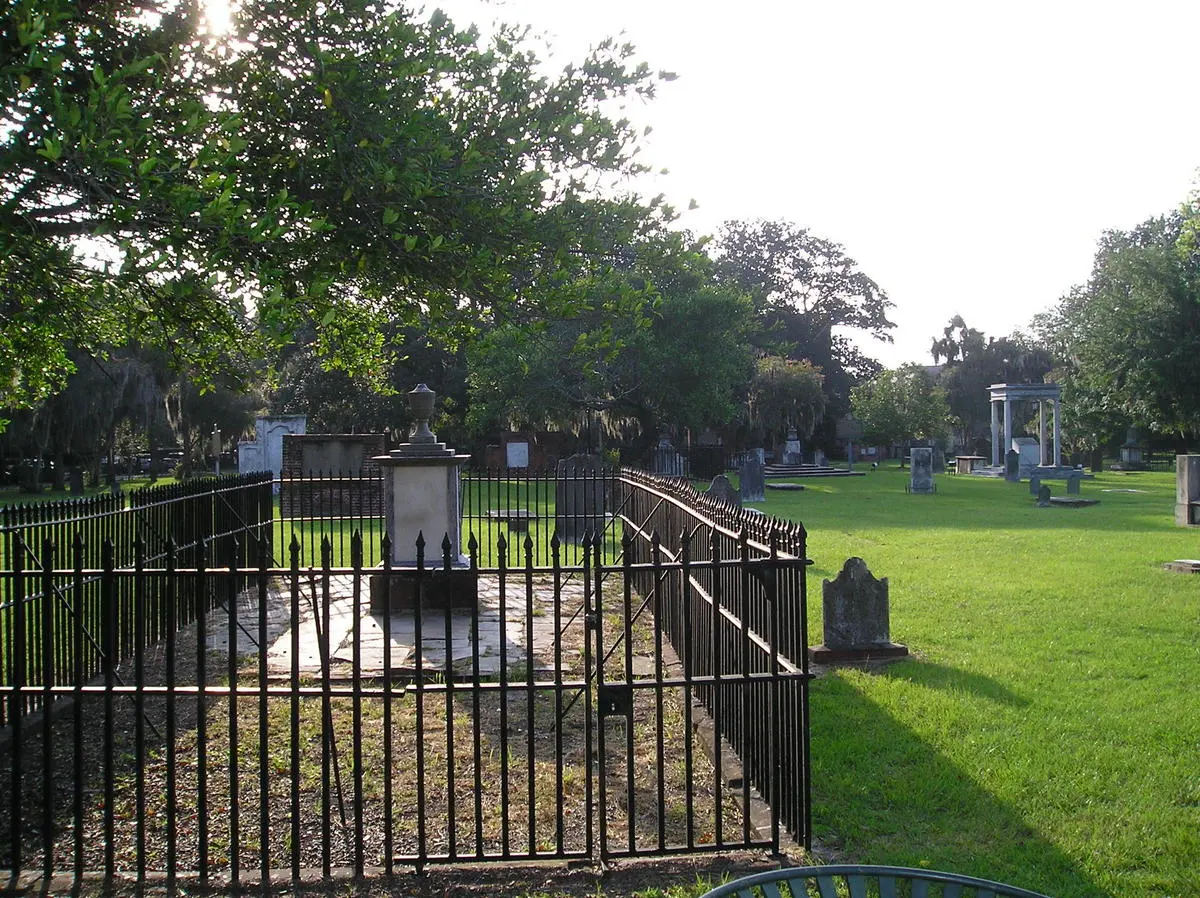
Family plots inside Colonial Park Cemetery, open to visitors by day. Photo: Jrozwado, CC BY-SA 4.0, via Wikimedia Commons.
Quick answer Savannah's oldest cemetery: 1750, 9,000 graves, free daytime visits
Colonial Park Cemetery opened in 1750 and closed to burials in 1853. It holds an estimated 9,000 graves on about six acres, including Button Gwinnett, a signer of the Declaration of Independence, and more than 700 victims of the 1820 yellow fever epidemic. The city opens it daily, from 8 am to 5 pm November to March and 8 am to 8 pm March to November. It closes at night, so ghost tours tell its stories from the sidewalk rather than entering.
Key takeaways
- The cemetery is at 200 Abercorn Street in the Historic District, steps from the squares covered in Most Haunted Places in Savannah, and a Self-Guided Walk
- Button Gwinnett's monument is here, though historians debate whether it marks his actual grave
- Union soldiers camped here after December 1864 and allegedly altered dates on some stones, a favorite story on the Ghosts and Gravestones Trolley Tour with Andrew Low House Entry
- More than 700 victims of the 1820 yellow fever epidemic lie here
- For a deeper cemetery visit, the daytime Bonaventure Cemetery Golf Cart Guided Tour covers a different cemetery across town
Colonial Park Cemetery at a Glance
Here is the practical picture in one place. The cemetery sits in the heart of the Historic District, so most visitors reach it on foot between squares. Hours differ by season, and it closes every night, which shapes how ghost tours handle it.
| Fact | Detail |
|---|---|
| Address | 200 Abercorn Street, Savannah, Georgia |
| Hours | 8 am to 5 pm November to March, 8 am to 8 pm March to November |
| Established | 1750, expanded three times by 1789 |
| Closed to burials | 1853 |
| Size | About 6 acres |
| Graves | An estimated 9,000 |
A Short History: 1750 to 1853
Colonial Park Cemetery opened in 1750 as Savannah's municipal burying ground. Over the following decades the city expanded it three times, reaching its current roughly six acres by 1789. For just over a century it took the city's dead, then burials ended in 1853.
That record makes it the oldest intact municipal cemetery in Savannah.
Its century of use spanned the hardest chapters of early Savannah. The 1820 yellow fever epidemic killed so many residents that more than 700 of its victims are buried here,. The Revolutionary War era left its own layer, including men who fought on both sides and at least one famous duel.
Through the Civil War
When Union troops occupied Savannah peacefully in December 1864, the cemetery passed through the war still intact, though not untouched.
The Graves Worth Finding
You can walk the whole ground in well under an hour, but a handful of markers draw most of the attention. This table covers the names people come looking for and why. Note the honest caveat on Gwinnett, which guides will tell you themselves.
| Name | Who they were | Dates | Why people look for it |
|---|---|---|---|
| Button Gwinnett | Signer of the Declaration of Independence | 1735 to 1777 | Killed in a 1777 duel with Lachlan McIntosh, historians debate whether the monument marks the actual grave |
| Lachlan McIntosh | Continental Army major general | 1725 to 1806 | Fought the duel against Gwinnett, both men rest in the same ground |
| Archibald Bulloch | First president of Georgia | Dates not stated | Great-great-grandfather of Theodore Roosevelt |
| Nathanael Greene | Revolutionary War major general | Lay here 1786 to 1901 | Shared the Graham vault with his British rival John Maitland, moved to Johnson Square in 1901 |
| Captain Denis N. Cottineau | Naval officer | 1745 to 1808 | His historical marker stands in the cemetery |
| James Wilde | Poet, remembered at the Duelist's Grave | Dates not stated | His duel was fought across the river in South Carolina |
| Victims of the 1820 yellow fever epidemic | More than 700 residents | 1820 | The deadliest single event in the cemetery's record |
The Greene and Maitland story is the strangest in the ground. Major General Nathanael Greene, the American commander, lay in the Graham vault from 1786 until 1901, when his remains were moved to Johnson Square. The British officer John Maitland, his adversary in the southern campaign, shared the same vault for far longer, with his remains returning to Scotland only in 1981.
If grave hunting whets your appetite, the largest and most ornate cemetery experience in Savannah sits a drive away at Bonaventure, reachable on the daytime Bonaventure Cemetery Golf Cart Guided Tour.
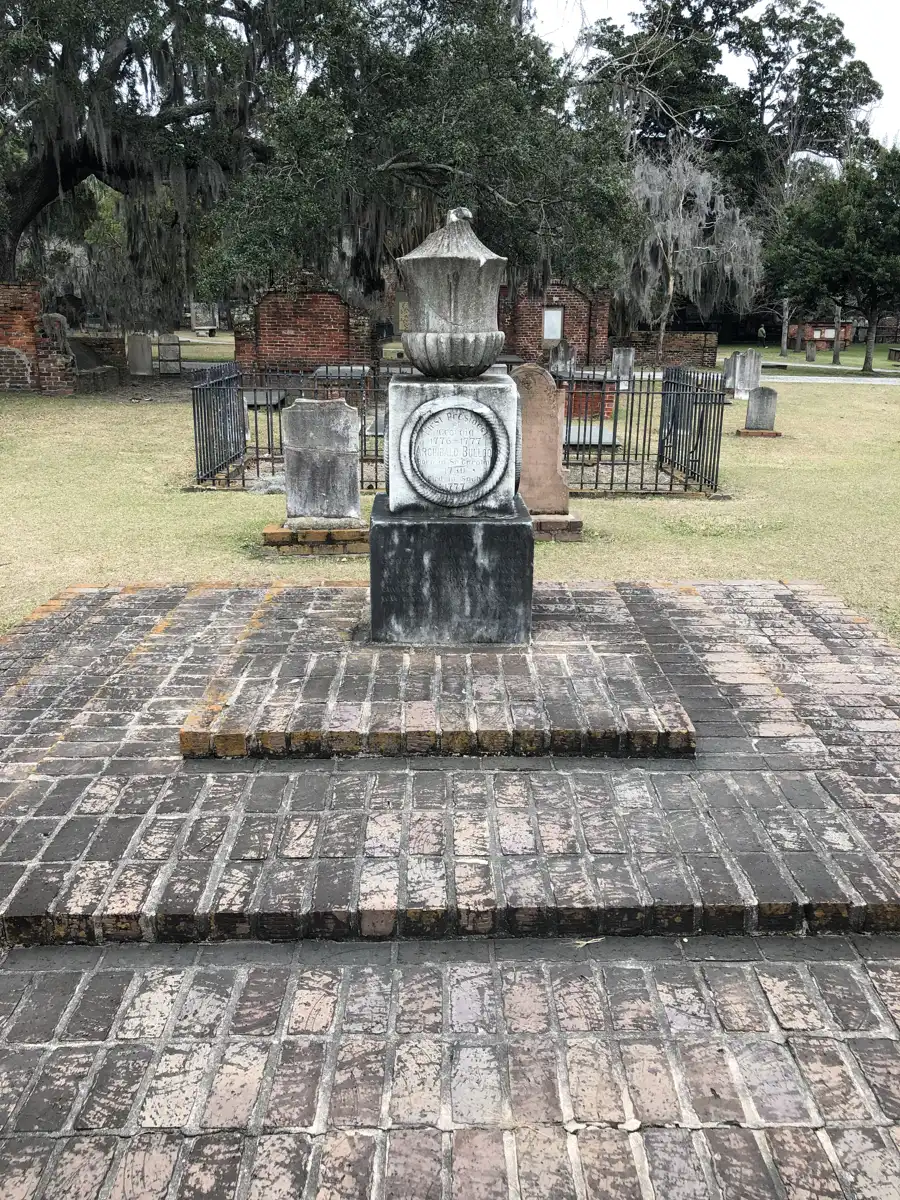
Archibald Bulloch's gravesite, one of the graves people come looking for. Photo: JHawk88, CC BY-SA 4.0, via Wikimedia Commons.
The Union Encampment and the Altered Stones
After Union troops occupied Savannah on 24 December 1864, several hundred soldiers camped inside the cemetery. The story goes that they damaged markers while camped among the graves, and that some of them altered dates on stones, changing ages and sometimes adding years to the carved inscriptions. Guides tell the story as they pass the cemetery walls.
How much of the story holds
The encampment itself is documented history, and the altered dates are the standard account repeated across the city's tours. The word usually attached is allegedly, because nobody has a complete record of which stones were changed and which were simply carved wrong in the first place. Guides who know their material present it the same way, as a well-grounded story with gaps rather than a settled fact.
It is the kind of burial-ground story the Dead of Night Adults-Only Ghost Walking Tour tells, for ages 16 and over, about the Historic District after dark.
Ghost Stories Told About Colonial Park
Here is the honest part. Colonial Park Cemetery is closed at night and no tour enters after hours, so everything ghostly about it is told from the street or the sidewalk. What the ground offers is history heavy enough that guides need little invention: an epidemic that filled it with the young, a duel that killed a signer of the Declaration, soldiers camping among the graves, and stones whose dates no longer add up.
The stories guides tell usually circle those facts. Guides speak of the fever victims of 1820 and the altered stones left by the Union encampment, and visitors report their own feelings among the old markers. Treat all of it as legend and atmosphere, not record.
The cemetery's real draw is that the documented history is already strange enough without embellishment.
If you want the fuller haunted picture of the neighborhood around Abercorn Street, including the Sorrel-Weed House a few blocks away on Madison Square, see our guide to Sorrel-Weed House, Savannah: History, Tours and the Molly Story. The Molly story there, like the altered stones here, is a legend with thin evidence behind it.
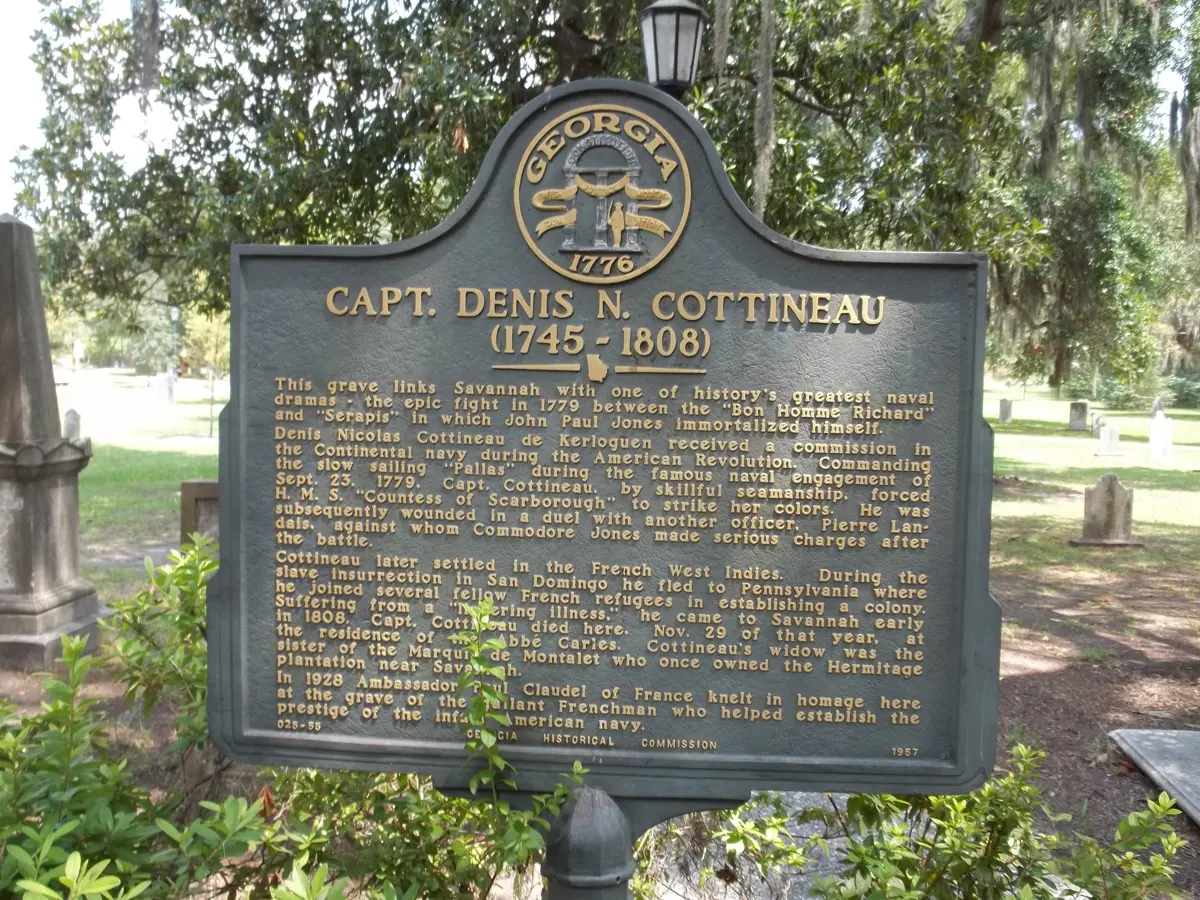
The marker for Captain Denis N. Cottineau (1745-1808). Photo: Ebyabe, CC BY-SA 3.0, via Wikimedia Commons.
Visiting: Hours, Entrances and Etiquette
The cemetery is a straightforward daytime visit. It sits at 200 Abercorn Street between the Historic District squares, and the gates open every day of the week. Plan around the seasonal hours, because the early 5 pm close in the colder months catches people out.
- Open 8 am to 5 pm from November to March
- Open 8 am to 8 pm from March to November
- Closed every night, with no after-hours entry for tours or visitors
- No admission price is stated in the city information, and the visit is self-guided
- The cemetery is inside the walkable Historic District, near Oglethorpe Avenue and Abercorn Street
Etiquette inside the gates
This is an active historic burial ground, not a park, so treat it as such. Stay on the paths, do not climb or lean on the stones, and keep your voice down near anyone else reading the markers. Photography in daylight is a normal sight.
Parents visiting with children may prefer to pair the stop with the Fraidy Cat Family-Friendly Ghost Tour of Savannah, which covers cemetery lore in a playful register designed for mixed ages.
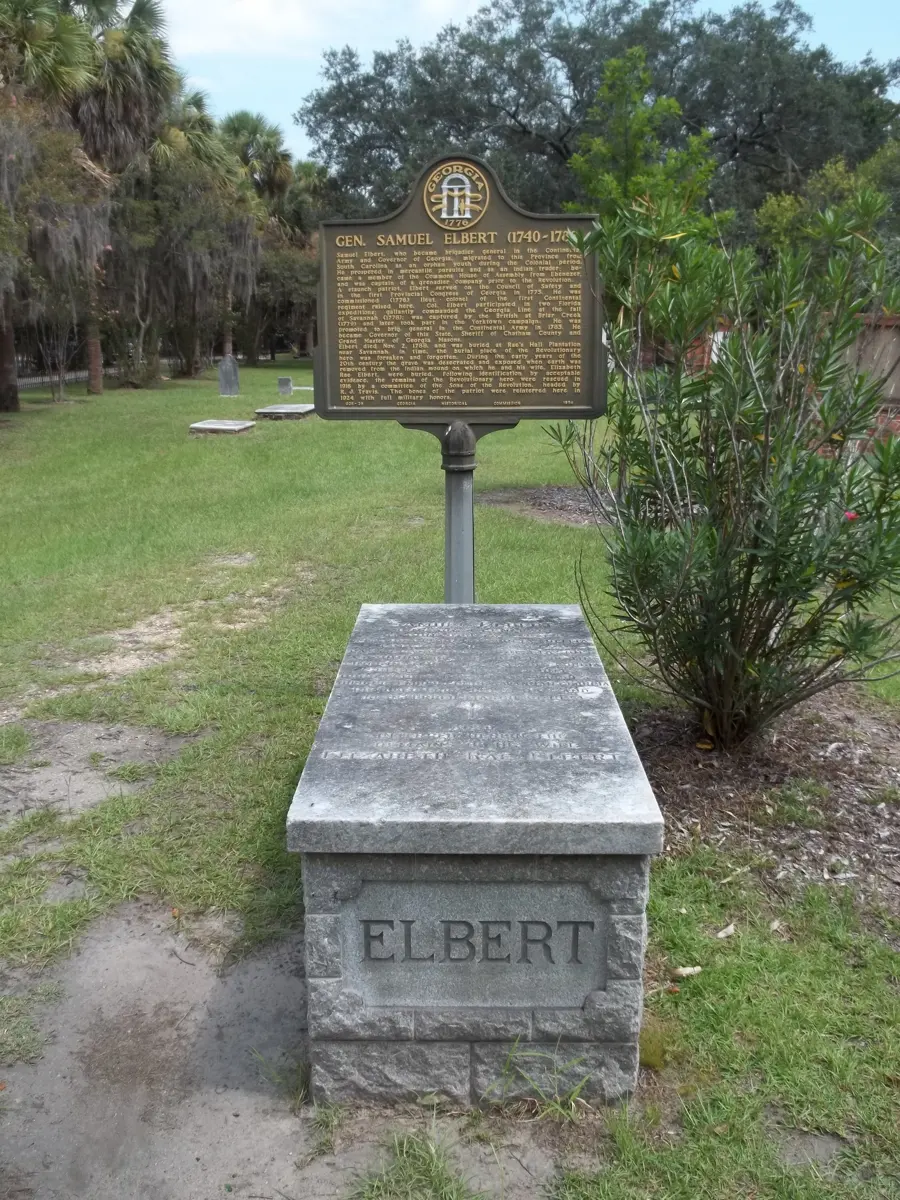
Samuel Elbert's grave marker, among the Revolutionary-era names in the ground. Photo: Ebyabe, CC BY-SA 3.0, via Wikimedia Commons.
Colonial Park and the Squares Around It
Colonial Park sits in the middle of a cluster of the stops every ghost walk talks about, which makes it an easy anchor for a daytime walk of your own. The cemetery fronts Abercorn Street and Oglethorpe Avenue. A few blocks south on Abercorn, Lafayette Square holds the Andrew Low House, built in 1849 for the father-in-law of Girl Scouts founder Juliette Gordon Low, which the Ghosts and Gravestones trolley enters at night.
To the east, Columbia Square has the fountain where the family ghost walk meets and the Kehoe House, an 1892 house that served as a funeral home for part of the 1900s.
Madison Square and Wright Square
West of the cemetery, Madison Square holds the Sorrel-Weed House, where Matilda Sorrel died by suicide and where the unverified Molly legend is told. North of it, Wright Square was laid out in 1733 and holds the grave of the Creek leader Tomochichi, buried there in 1739. Ghost walks tell that Alice Riley, hanged in the square in the 1730s, still haunts it, a legend rather than a record.
Our self-guided walk strings these squares together with the cemetery in walking order.
A one-hour route inside the gates
Enter from Abercorn Street and start with the Gwinnett monument, then look for the Bulloch gravesite and the marker for Captain Denis N. Cottineau, whose dates run from 1745 to 1808. The Duelist's Grave remembering poet James Wilde is the stop most guides mention by name. Leave time for the brick vaults: the Graham vault held Nathanael Greene from 1786 to 1901 and his rival John Maitland until 1981.
Read the dates on the older stones as you go, since the story of altered numbers from the 1864 encampment is easier to judge in front of the marble than on a tour bus.
Before or after a night tour
A daytime visit makes a night walk better. If you have already read the names on the stones, the stories told from the sidewalk after dark land harder, and you know which parts are record and which are legend. Most night walks start within a few blocks: the candlelit walk faces Chippewa Square, the adults-only walk checks in at Johnson Square and the family walk meets at the Columbia Square fountain.
On some holiday dates the Ghosts and Gravestones trolley leaves from 250 MLK Blvd and makes a stated stop at Colonial Park Cemetery itself, the only listing compared here that names one. Check that listing's booking notes for the dates before you plan around it.
Photographing the cemetery
Daylight is the only light you get, since the gates close in the evening, and the oak canopy keeps much of the ground in shade. The brick vaults and iron-fenced family plots photograph best from the paths. Keep the camera off anyone else's graveside visit, never step onto a grave or lean on a marker for an angle, and remember the stones are fragile after more than 170 years without new burials.
Which Ghost Tours Tell Its Stories
No tour enters Colonial Park Cemetery after dark, so the night walks and trolleys tell its stories from the street as they pass. Which one suits you depends on budget, group and appetite for the darker material. The walk formats cover the ground closest to it, while the trolley reaches it as one stop among several.
| Tour | Format | Duration | Price |
|---|---|---|---|
| Savannah Candlelit Ghost Walking Tour | On foot, lantern lit | 90 minutes | $39 per person |
| Dead of Night Adults-Only Ghost Walking Tour | On foot, 16 and over | 90 minutes | $34.99 per person |
| Ghosts and Gravestones Trolley Tour with Andrew Low House Entry | Night trolley | 80 minutes | $43 per person |
The candlelit walk is the closest fit for most visitors, running lantern-lit departures through the Historic District squares, and the Dead of Night walk covers the same ground with grimmer stories for ages 16 and over. The Ghosts and Gravestones trolley suits anyone who would rather ride, adding entry to the Andrew Low House and the Perkins and Sons Ship Chandlery. Whichever you pick, book the evening slot ahead in October, when several listings already carry a likely-to-sell-out flag.
Which Tour Fits Your Night
If You want the classic Savannah experience of lantern light, oaks and stories near the cemetery
Take the Savannah Candlelit Ghost Walking Tour, a 90-minute walk through the Historic District squares
If You are 16 or older and want the darkest burial-ground stories rather than family fare
Book the Dead of Night Adults-Only Ghost Walking Tour, which tells the district's murder and burial tales from the street
If You would rather ride than walk, and want a house entry included
The Ghosts and Gravestones Trolley Tour with Andrew Low House Entry adds the Andrew Low House and a River Street warehouse stop
If You are visiting with young children and want cemetery lore kept gentle
Choose the Fraidy Cat Family-Friendly Ghost Tour of Savannah, built for mixed ages with leashed pets welcome
If You want to build your own route through the haunted addresses
Start with our self-guided walk through the Most Haunted Places in Savannah, then visit Colonial Park Cemetery by daylight
Questions About Colonial Park Cemetery
Who famous is buried in the Colonial Park Cemetery?
Button Gwinnett, a signer of the Declaration of Independence, is buried or memorialised here, though historians debate whether his monument marks the actual grave. Continental Army major general Lachlan McIntosh, who killed Gwinnett in a 1777 duel, is also here, along with Archibald Bulloch, the first president of Georgia and great-great-grandfather of Theodore Roosevelt. Major General Nathanael Greene lay in a vault here from 1786 until 1901.
What is the most haunted cemetery in Savannah, Georgia?
That title usually goes to Colonial Park Cemetery in popular retellings, thanks to its 1820 fever victims and the stones allegedly altered by Union soldiers. Bonaventure Cemetery is the other name that comes up, though it is known more for beauty than hauntings. Savannah itself was named America's Most Haunted City by the American Institute of Parapsychology in 2002, a title the institute's founder called more honorary than scientific.
Why is the Colonial Park Cemetery famous?
It is the oldest intact municipal cemetery in Savannah, established in 1750 and closed to burials in 1853. It holds an estimated 9,000 graves on about six acres, including a signer of the Declaration of Independence and more than 700 victims of the 1820 yellow fever epidemic. The story that Union soldiers camped here in 1864 and altered dates on the stones draws constant attention from tour guides.
Can you visit Colonial Park Cemetery at night?
No. The cemetery closes at 5 pm from November to March and at 8 pm from March to November, and it is closed every night. No ghost tour enters after hours. The night walks tell its stories from the street as they pass.
Is Colonial Park Cemetery free to visit?
The city information for the cemetery states no admission price, and visits are self-guided during opening hours. Daytime entry differs from the commercial night tours, which tell the cemetery's stories from outside for their ticket price. Check posted signs at the gate for anything current.
How long do you need at Colonial Park Cemetery?
Most visitors see the notable graves in 30 to 60 minutes, since the grounds cover about six acres and the highlights sit close together. Add time if you want to read the stones carefully. Pairing it with the surrounding squares fills out a good half-day of the Historic District on foot.
Visit Colonial Park Cemetery by daylight for the history, then hear it again after dark from the guides who know the stories best. The night walks cannot take you inside the gates, but standing outside them by lantern light, with the altered stones and fever graves a few steps away, is how Savannah has always told this story. Compare the night ghost tours in Savannah GA to pick the walk that fits your evening.